
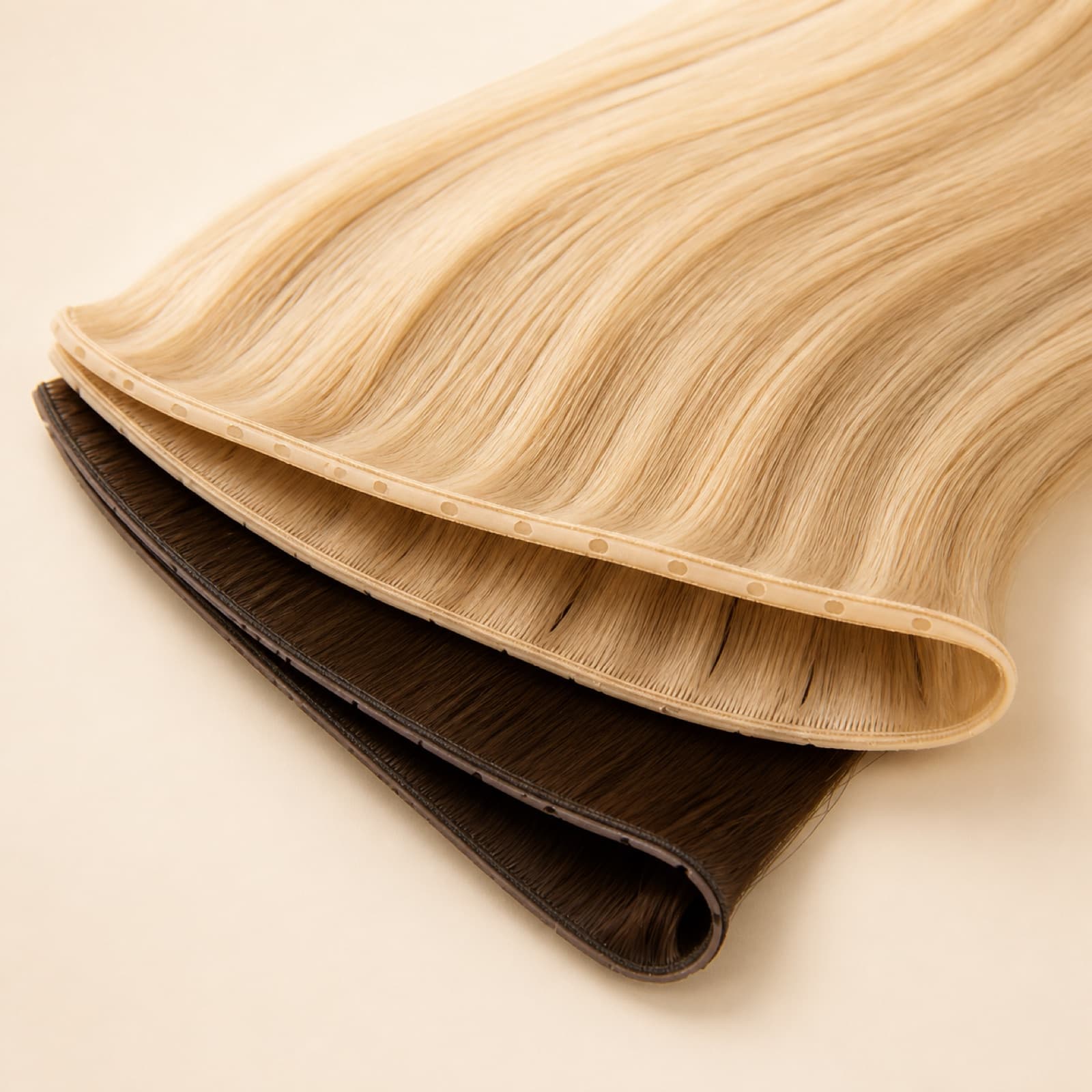
A buyer choosing a weft is choosing more than a hair color. The seam, its profile, how the hair is attached to it and the way the stylist builds a row all affect the product’s practical fit. “Genius” and “hand-tied” are familiar search terms, but suppliers do not always use those names for identical constructions. The safest comparison starts with a physical sample and a written specification.
This guide compares five common weft descriptions—genius, hand-tied, machine, flat and butterfly—from the perspective of a salon, professional brand or distributor. It focuses on what a buyer can inspect and ask about. It does not promise that one construction is universally more comfortable, invisible or durable; those outcomes depend on the exact product, fitting technique, hair and client.
Define the terms before comparing prices
A weft is a curtain of hair attached at a top seam. The seam allows a stylist to install the hair along a prepared row by a suitable method. Product names usually signal a construction idea, but they are not a substitute for dimensions, edge treatment and handling instructions. Two suppliers may label wefts with the same name while supplying different seam heights or finishing details.
When requesting a quote, ask the supplier to state whether the weft may be cut, where, and what finishing is required after cutting. Never infer cuttability solely from “thin” or “flat.” A hand-tied weft, for example, may have a construction that can unravel if cut incorrectly. Other constructions may also need sealing or defined cut points. The exact sample and supplier instructions should govern the decision.
To compare fairly, hold the hair specification constant. A light, long, heavily processed color can feel different from a dark, shorter sample even when the seam is identical. Request comparable length, weight, texture and shade where possible. Then measure or photograph the seam against the same reference scale and assess it under the installation method your stylists actually use.
Five questions to send every supplier
- What is the seam construction and approximate profile for the quoted SKU?
- Can the weft be cut to width? If so, how should each cut edge be secured?
- What are the available width, length, weight and hair-grade options?
- Is the quoted sample representative of bulk production?
- How are seam integrity and pack consistency checked before dispatch?
These questions do not rank one weft above another. They reveal whether the vendor understands the product it is offering and whether your stylists can plan a controlled trial.
Compare five weft constructions
Genius weft
Genius weft is commonly marketed as a slim, flexible weft intended to combine a low seam profile with practical customization. The exact meaning is supplier-specific. Some versions allow cutting and some may still require care at the edge. Ask for a close-up seam photo, a sample and written cutting guidance. Examine whether short return hairs are visible near the top, how the seam behaves when bent and whether the finished ends remain stable after any approved modification.
For a brand, the commercial appeal is a concise product story around a refined seam. The risk is treating a category name as a universal specification. Define seam width, expected hair weight per piece and how a finished piece is labeled. If you intend to create salon training, test the actual production sample with your row method before writing instructions.
Hand-tied weft
Hand-tied wefts use a hand-constructed seam and are often selected when a fine seam profile is important. They may be supplied in shorter pieces and assembled across a row. Their construction and edge treatment deserve particular attention. Unless a supplier explicitly confirms a safe cutting method for that SKU, plan the installation around intact weft pieces.
Hand-tied is not automatically the best choice for every client. The number of pieces needed, the thickness of the finished row and the stylist’s placement technique matter. Ask how many pieces are in a pack, the width of each piece and the usable hair weight. A lower profile at a single seam does not necessarily mean a thinner finished installation if many pieces are stacked.
Machine weft
Machine wefts are stitched by machine and often have a more substantial seam. Their construction can suit stylists who want a defined base and flexible width planning, subject to the supplier’s cutting instructions. The feel and visibility of the seam depend on the SKU, especially when the row is placed high or near a fine hairline.
For wholesale programs, machine wefts can be straightforward to merchandise because buyers recognize the term. Still, compare seam thickness, hair distribution and the finish at both ends. Ask whether the specified weight refers to the full weft or a segment. A quote for “one bundle” is difficult to compare without the width and weight.
Flat weft
Flat weft generally describes a construction designed to sit with a flatter top profile than a traditional bulky machine seam. The term does not tell you how the seam is built, whether it can be cut or how its edge should be finished. Ask for a side-view photo and sample, then compare it under light tension and when folded or layered as it would be during application.
If you market a flat weft as part of a professional line, explain the measurable feature that makes it relevant to your customer. A statement such as “flat profile for selected row methods” is easier to support than an absolute promise of invisibility. Test whether the seam is comfortable at the intended placement and whether the row remains manageable for your stylists.
Butterfly weft
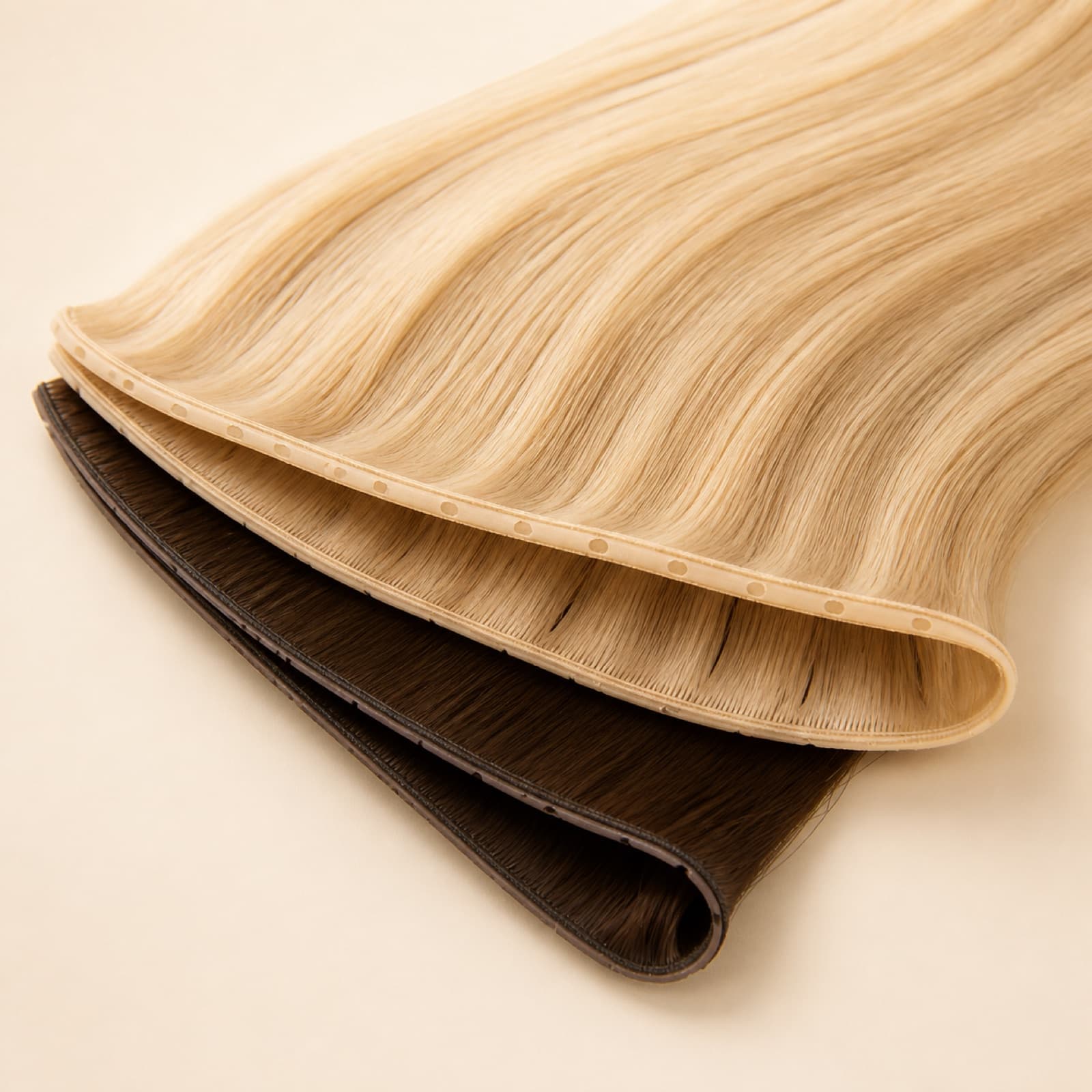
Our Butterfly Weft has hair wefts on both sides of a perforated middle section. The most common version uses Genius Weft on both sides. The perforations make installation easier and faster, helping stylists add volume quickly. For a wholesale order, confirm the piece size, weight and edge handling of the version being quoted.
For a new method, the most useful evidence is a controlled salon trial. Have the same experienced professional document placement, styling access, profile and removal or maintenance planning according to the method used. Record the hair and scalp context of the test so that you do not overgeneralize one result to all clients.
At-a-glance buying comparison
| Weft type | Typical buyer question | Confirm on the actual sample |
|---|---|---|
| Genius | Is the seam slim and customizable for our row method? | Width, profile, permitted cutting, edge finish |
| Hand-tied | Can we build a fine row from intact pieces? | Piece widths, pack count, seam ends, layering |
| Machine | Does the defined seam suit our placement and price band? | Seam thickness, weight, width, cut guidance |
| Flat | How flat is it in our real installation? | Side profile, flexibility, edge treatment |
| Butterfly | How does this specific construction fit our technique? | Attachment method, piece dimensions, training needs |
This table is a purchasing framework, not a product-performance ranking. A lower-looking seam in a photograph can behave differently once installed, and labels are not standardized across the industry.
Choose for the salon workflow, not the label
Start with the service you want to offer. How are rows placed? What is the typical hair density of the clients for whom the service is intended? How many pieces will the stylist combine? How often will the installation be maintained? Does your team already have training for that construction? These questions can narrow the sample set before price comparison.
An extension specialist may prioritize a delicate top profile for a particular placement. A busy salon group may prioritize consistent pack contents and a process that is easy to train. A distributor may need clear differences between constructions so its salon customers can choose without confusing names. Each business can arrive at a different sensible shortlist.
Consider the complete SKU
The hair attached to the seam matters as much as the seam itself. Confirm root-to-end fullness, texture consistency, color finish and hair movement on comparable samples. Check whether the ends meet the visual standard your brand intends to show. If a style requires multiple pieces, review the resulting color blend and weight rather than one strip in isolation.
For private label, decide whether products will be sold by gram, number of wefts, or finished pack. Write that on the specification and customer-facing label. A stylist should know what is in the pack before opening it, and your reorder system should identify the exact version. Packaging should protect the weft ends and make color and length easy to verify.
Do not turn a supplier’s generic installation claim into a universal recommendation. Suitability and maintenance depend on professional assessment and the client’s hair. When publishing care or training instructions, have a qualified stylist review them against the exact item you sell.
Run a useful sample comparison
Order at least one representative sample of each shortlisted construction in a comparable shade and length. Before any application, photograph the front, back, side profile and end of the seam. Record stated and measured width and weight under the same conditions. Ask the supplier whether measurements include the seam and how tolerances are defined.
Then let trained stylists handle the samples. Have them comment separately on sectioning, row preparation, ease of attachment, ability to distribute the hair, visibility at the intended placement and any edge finishing needed. A structured score sheet is more valuable than a single favorite selected by appearance. It also gives the factory a practical basis for discussing a change.
If the supplier permits cutting, test only according to its written guidance and examine the cut edge after handling. Do not cut a hand-tied or unfamiliar weft simply to see what happens. If a piece is intended to remain intact, evaluate whether available widths give the stylist enough flexibility. That can be a more important buying criterion than a small difference in seam thickness.
After an installation trial, ask for feedback at the normal follow-up interval for that method. Record the installation technique, care instructions, any styling or maintenance issues and whether they appear related to construction. One installation cannot prove long-term performance, but it can reveal obvious handling problems and help write better questions for the next sample round.
For bulk approval, retain one signed-off reference sample and a clear product sheet. The product sheet should show construction name, hair specification, shade, length, weight, pack quantity, seam width or piece size, cutting instruction, label code and artwork revision. Ask how the factory will handle any change to a seam component before the next order.
If you want to compare methods for your own line, send us your weft requirements. Include the row technique you use and the questions your stylists need the sample to answer.
Compare the economics of a complete service
For a salon, the purchase price of a weft is only one part of the service cost. Record how many pieces and how much hair are normally used for the result you intend to sell, how long preparation and fitting take for a trained stylist, whether any unused piece can be retained, and what maintenance products or training the method requires. This is a planning exercise, not a universal claim that one weft saves labor. The answer depends on the salon team and the chosen installation technique.
For a distributor, compare quotations on an equivalent basis. Convert each offer to the same hair weight, length, shade complexity and pack content, then account for packaging and shipping assumptions. If the supplier quotes a hand-tied piece and a machine weft by different units, comparing the headline price misleads. A clear worksheet should show each SKU’s piece count, total width, total weight and any loss when widths are adjusted for fitting.
For an emerging private-label brand, reserve room for technical support. You may need sample photography, shade swatches, a stylist training sheet and accurate product-page instructions. If the construction requires a specific edge-handling rule, make that rule visible to the salon buyer. Consistent education protects the brand more effectively than an unexplained “premium” badge.

Buyer FAQ
Is genius weft the same as hand-tied weft?
No. They are marketed as distinct construction types, although their appearance and claims can overlap. The exact seam, piece format and cutting rules depend on the supplier. Compare physical samples and written instructions rather than assuming the names define identical properties everywhere.
Can all wefts be cut to fit a row?
No universal cutting rule applies. Some constructions may permit cutting with edge treatment; others should remain intact. Request written SKU-specific guidance and train stylists accordingly. If the preferred piece cannot be cut, choose widths that suit the service.
Which weft is least visible?
Visibility is a result of product profile, placement, hair density, color matching and styling. A slim seam may help in a suitable location, but no construction is invisible for every client. A salon test on the intended client type is more meaningful than a general claim.
What should a distributor put on the product label?
At a minimum, make method, shade, length, pack content and reorder code clear. Depending on the market, you may need additional material, origin, care or company information. Check target-market requirements before finalizing artwork and make the artwork revision part of the order specification.
Conclusion
Genius, hand-tied, machine, flat and butterfly wefts serve different installation and merchandising priorities. Use their names to build a shortlist, then compare actual seam construction, hair specification, pack content and salon handling. A sample-based decision and an unambiguous reorder sheet make the choice useful long after the first sale.